Audio Companion
Listen to this reflection
Use the controls below to have your browser read this post aloud.
There are some Bible phrases that make people tense up before the conversation even begins. “Weaker vessel” is one of them. For some, it sounds like Scripture is calling women inferior, and for others, it has been used to justify the very kind of harshness Peter seems to be warning husbands against.
I understand why the phrase can be difficult. I have heard people talk about it in ways that felt dismissive, careless, or incomplete, and in my normal overthinking, deep-thinking way, I eventually had to slow down and read the verse again for myself. Not just repeat what I had heard. Not just react to the phrase. I needed to sit with the actual words of Scripture and ask what Peter was really saying.
Years ago, as I was meditating on this passage, the image of a vessel started to stand out to me. A vessel can be more delicate without being less valuable. In fact, many delicate vessels are handled with greater care precisely because they are precious. That thought has stayed with me for years, and I have used it in small group and ministry conversations when discussing this passage, especially when trying to explain that “weaker” does not mean lesser, inferior, or spiritually beneath.
1 Peter 3:7 ESV says, “Likewise, husbands, live with your wives in an understanding way, showing honor to the woman as the weaker vessel, since they are heirs with you of the grace of life, so that your prayers may not be hindered.” That sentence does not stand over wives to reduce them. It stands before husbands to sober them. Peter does not use “weaker vessel” to lower a wife’s worth; he uses it to raise a husband’s responsibility.
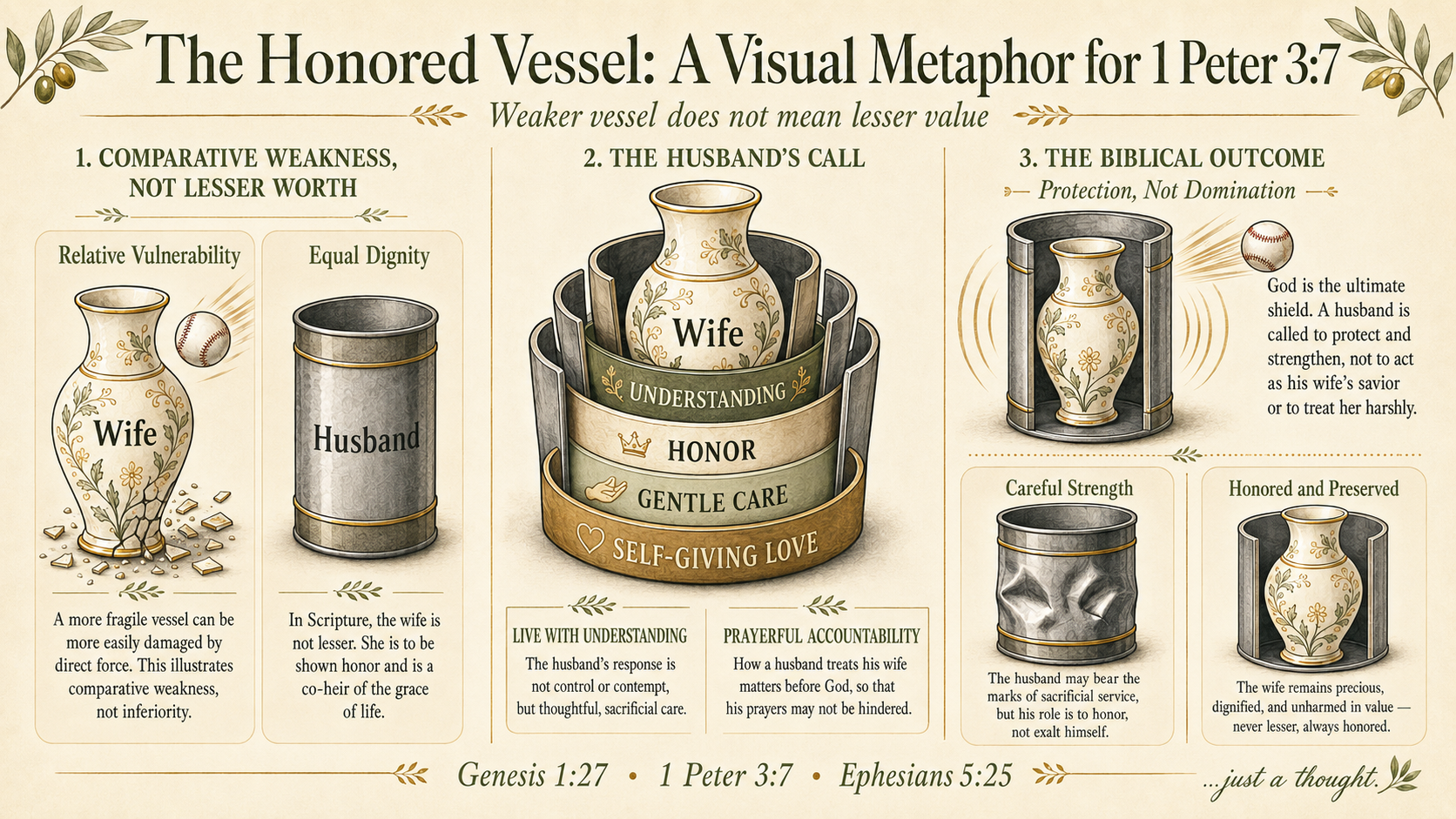
That distinction matters because the phrase “weaker vessel” can easily be isolated from the rest of the verse. When that happens, it can begin to sound like a statement of hierarchy, value, or capability. But Peter immediately surrounds the phrase with understanding, honor, shared inheritance, grace, and spiritual accountability.
Whatever else we wrestle through in the passage, the verse itself refuses to let a husband treat his wife as less.
A wife may be the “weaker vessel” in the ordinary sense of comparative physical vulnerability, but Peter does not connect that vulnerability to inferiority. He connects it to honor. That is a very different kind of instruction. He is not saying, “She is weaker, so rule over her.” He is saying, “She is to be honored, understood, and treated with care because she is precious and because she stands with you as an heir of grace.”
That is where the vessel image helps me. If I place a porcelain vase beside a tin container, the porcelain is more vulnerable to direct force. If a baseball hits the vase, it may crack or shatter. If the same baseball hits the tin container, the tin may dent, but it can remain standing. That difference is real, but no one would honestly argue that the tin is more valuable because it is harder to break.
In many cases, the opposite is true. The more delicate vessel is often the one we treat with greater care. We do not protect it because it is worthless. We protect it because it matters. Its vulnerability does not diminish its beauty, purpose, or value. It simply changes how it should be handled.
That is the part I think we sometimes miss in this passage. Peter is not giving husbands permission to be proud of their strength. He is calling them to be careful with it. Strength in Scripture is never meant to become an excuse for control, intimidation, harshness, or self-importance.
In the hands of a sinful man, strength can become dangerous. In the hands of a Christ-shaped man, strength becomes service.
This is why Peter’s command begins with understanding. A husband is not called to live with his wife according to assumption, frustration, stereotype, or convenience. He is called to know her. He is called to pay attention. He is called to consider her heart, her burdens, her fears, her joys, her story, her body, her limits, her strengths, and the ways she experiences life differently than he does.
Understanding does not mean a husband will always immediately comprehend everything his wife feels or needs. It means he refuses to be lazy with her heart. It means he does not dismiss what he has not taken time to understand. It means he approaches her as someone entrusted to him, not as someone beneath him.
Then Peter says to show honor. That word should slow us down. Honor is not the same as merely avoiding harm. A husband can avoid obvious cruelty and still fail to honor his wife. Honor means he treats her as weighty, valuable, dignified, and worthy of care. It means his words, decisions, tone, habits, and private attitudes should reflect that she is precious before God.
This is where the passage becomes deeply practical. A husband cannot claim to honor his wife while consistently belittling her, ignoring her, intimidating her, embarrassing her, or treating her concerns as annoyances. He cannot use Scripture to demand respect while refusing the part of Scripture that commands him to give honor.
Biblical headship, however one works through the larger conversation, can never be separated from Christlike sacrifice.
Ephesians 5 gives us that larger picture. Husbands are called to love their wives as Christ loved the church and gave Himself up for her. That kind of love does not use authority to take. It uses strength to give. It does not crush what is vulnerable. It moves toward what is vulnerable with patience, protection, tenderness, and care.
This is also why we have to be careful with the idea of protection. Protection is not domination. A shield protects by absorbing harm, not by suffocating what it protects. A husband is not his wife’s savior, and he is not called to replace God in her life. Christ is her Lord, her Redeemer, her refuge, and her ultimate covering.
A husband’s role is humbler than that, but still serious. He is called to be a faithful servant within the covenant, using whatever strength, influence, presence, and leadership he has for her good. If he bears the marks of sacrifice, those marks should not become trophies for his ego. They should simply be evidence that he chose love over self-protection.
That may be one of the hardest parts for husbands to receive. Peter does not end the verse by saying, “Do this so your marriage will look respectable.” He says to do this “so that your prayers may not be hindered.” In other words, how a husband treats his wife matters before God. The private tone, the careless words, the harsh reactions, the indifference, the selfishness, and the unwillingness to understand are not hidden from the Lord.
That should sober every husband, because God does not seem impressed by public spirituality that is contradicted by private harshness. A man may pray eloquently, serve visibly, lead confidently, and speak biblically, but if he dishonors his wife, Peter says something is wrong.
His marriage is not separate from his walk with God. It is one of the places where his walk with God is revealed.
At the same time, this passage should not be turned into a weapon against husbands who are sincerely trying to grow. There is a difference between a man who struggles imperfectly toward Christlike love and a man who uses strength to excuse selfishness. Most husbands will have moments where they look back and realize they could have listened better, spoken softer, cared more patiently, or paid closer attention. The point is not perfection. The point is repentance, humility, and growth.
That is why I keep coming back to the honored vessel. The wife is not honored because she is weak in value. She is honored because she is made in the image of God, joined with her husband as a co-heir of grace, and entrusted to him in covenant love. Her dignity does not come from her husband’s treatment of her, but his treatment of her should agree with the dignity God has already given her.
The metaphor is not perfect because no metaphor is. A wife is not merely porcelain, and a husband is not merely tin. Women are not helpless, and men are not automatically strong in all the ways that matter. Many wives carry incredible spiritual, emotional, intellectual, and relational strength, and many husbands have to learn that true strength is not proven by control but by humility.
Still, the picture helps me see the passage more clearly. The issue is not whether one vessel can withstand more force than another. The issue is whether the more durable vessel understands why durability was given. If strength does not lead to honor, it has already been misused.
If leadership does not look like sacrificial love, it has drifted away from Christ.
Maybe that is the invitation in 1 Peter 3:7. Not for wives to see themselves as lesser, and not for husbands to see themselves as greater, but for both to remember what God says is true. She is to be honored. He is accountable for how he handles her. They are heirs together of the grace of life.
And in a world that often confuses strength with power, maybe Christian marriage is meant to show something better. Strength can be gentle. Honor can be practical. Protection can serve without controlling. Love can absorb the cost without making itself the center.
“Weaker vessel” was never meant to mean lesser value. It was meant to call forth greater care.
“…just a thought.”